
The first real snow of the year always shows up the same way inside a building.
Wet footprints by the front door.
Gritty white crunch across the entry tile.
A chalky haze on the lobby floor that wasn’t there last week.
Winter floor care in Northern Indiana isn’t really about snow. It’s about what comes in with it. Slush, grit, mud and a steady supply of rock salt tracked across your floors by every person who walks through your doors.
Left alone, that salt does real damage. It dulls finishes, eats into grout, leaves permanent white marks on hard floors and works deep into carpet near the entrances.
The good news is that almost all of it is preventable.
The question isn’t how to clean up salt. It’s how to keep it from reaching your floors in the first place.
Here’s what salt actually does to a commercial floor, and what a winter cleaning plan should look like for a building anywhere near Lake Michigan.
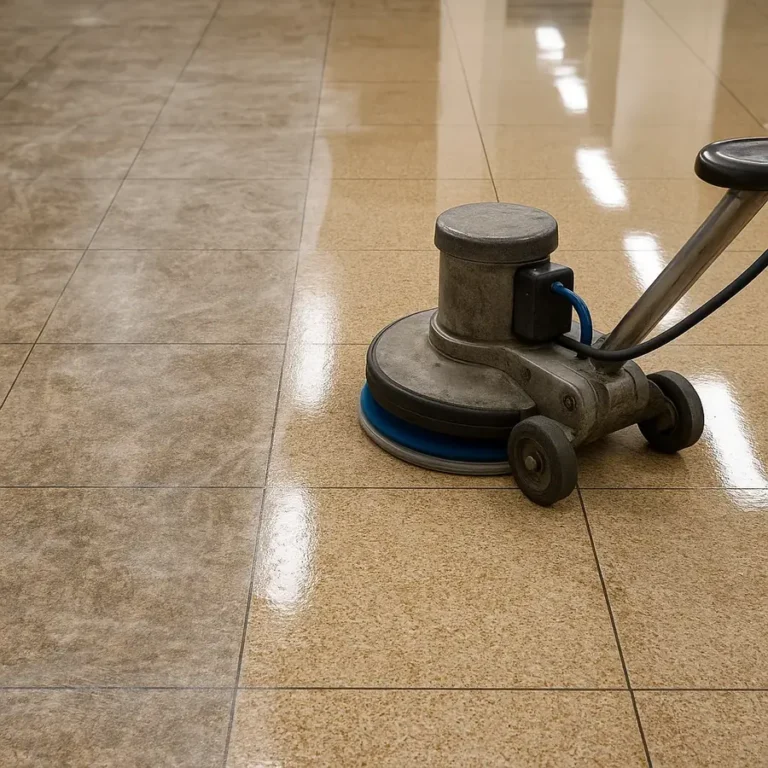
1. What Salt Actually Does to Your Floors
Rock salt is not just dirt you can mop away.
It’s an abrasive, and it’s chemically active.
Walk it across a floor and two things happen at once. The grit scratches the surface like sandpaper, and the salt itself draws moisture and reacts with whatever it’s sitting on.
What that looks like depends on the floor:
- VCT and vinyl tile: Dulled finish, scratches and a white film that keeps coming back after mopping
- Polished concrete: Pitting, surface damage and a chalky haze that spreads with foot traffic
- Tile and grout: Salt settles into the grout lines, where it holds moisture and discolors over time
- Hardwood and luxury vinyl plank: White marks, dull spots and damage where water sits along seams
- Carpet: Salt crystals work down into the fibers near entrances, leaving stiff, discolored traffic lanes
- Entrance mats: They fill up with salt and stop absorbing, then start redistributing it back onto the floor
The damage is slow, and that’s what makes it expensive.
You rarely notice it in January.
You notice it in April, when the lobby floor looks worn out and the fix is no longer a mop. It’s a strip and refinish, or new carpet.
2. The White Haze Isn’t Coming Back Because Your Cleaner Is Lazy
Here’s the part most building managers get wrong.
Salt residue is alkaline.
Most everyday floor cleaners are neutral or alkaline too, so mopping with them doesn’t dissolve the salt. It spreads it around, leaves a film behind and the haze returns as soon as the floor dries.
That’s why a floor can be mopped every night and still look chalky all winter.
Removing salt residue properly takes a neutralizer, a mildly acidic cleaner made for exactly this problem, followed by a clean rinse. Done right, the haze lifts and stays gone until the next round of salt arrives.
Done wrong, you’re just relocating salt from one part of the floor to another, night after night, while the grit keeps grinding away at the finish.
If your floors look worse in February than they did in November no matter how often they’re cleaned, this is usually why.

3. Your Entryway Does Most of the Work
The cheapest winter floor care happens in the first fifteen feet of your building.
A proper matting system has three parts, and most buildings only have one:
- Outside the door: A scraper mat that knocks off snow, grit and chunks of salt before anyone steps inside
- Just inside the door: A heavy wiper/scraper mat that catches what’s left
- Past the entry: An absorbent runner that pulls the remaining moisture off shoes
The goal is simple: by the time someone reaches your lobby carpet or finished floor, their shoes should be dry.
A few things that make matting actually work:
- Length matters more than quality. A long runner beats a small premium mat.
- Mats have to be cleaned or swapped. A saturated mat is worse than no mat, because it holds salty water against the floor and releases it onto shoes.
- Side and back entrances need mats too. That’s where staff come in, usually in the worst weather.
- Mats need to lie flat. A curled winter mat is a trip hazard.
Spending a little on matting in October is far cheaper than refinishing a lobby in April.
4. What Should Change in Your Cleaning Schedule From November to March
A cleaning plan built for July won’t hold up in January. The same building, with the same number of people, suddenly needs more attention in specific places.
During winter months, most Northern Indiana businesses need:
- More frequent entry and lobby floor care, often daily, sometimes more than once a day
- Salt neutralizer added to the mopping routine instead of standard floor cleaner
- Mats cleaned, vacuumed or swapped out on a set schedule, not when someone notices
- More frequent vacuuming of carpet near every entrance
- Extra attention after heavy snow or ice days
- Mid-winter carpet extraction in entry areas, rather than waiting until spring
It doesn’t necessarily mean adding cleaning nights. Often it means shifting the work you’re already paying for toward the areas winter actually hits, and treating the entry as its own zone with its own schedule.
If you’re not sure how your current plan is built, it’s worth reviewing what tasks commercial cleaning usually covers and how often your building should be cleaned before the snow starts.
5. The Slip Risk Nobody Budgets For
Wet winter entryways are one of the most common places people fall inside a commercial building.
Melted snow pools on hard floors. Salt residue makes a surface look dry when it isn’t. Someone walks in from the parking lot moving quickly, hits a slick spot, and now you have an incident report, or worse.
A winter floor plan should include:
- Wet floor signs out during and after snow, not just while mopping
- Mats that stay flat and get swapped before they’re saturated
- Entry floors checked and dried during the day, not only at night
- Someone responsible for the entry during business hours when weather turns
This is where a day porter earns their keep in winter. Nightly cleaning can’t do anything about a wet lobby at 10 a.m.
6. What to Do Before the First Snow
Most of winter floor care is decided in the fall.
Before the weather turns, it’s worth getting these in place:
- Deep clean and protect hard floors now. A properly sealed and finished floor resists salt far better than a worn one. Hard floor scrubbing and refinishing is much easier in October than in February.
- Clean the carpet before winter, not just after. Starting the season with clean entry carpet means salt has less to bond to.
- Check your tile and grout. Sealed grout holds up to salt and moisture. Unsealed grout soaks it up.
- Order matting early. Measure your entries and buy length, not squares.
- Confirm your cleaning company stocks neutralizer. Ask directly. Not every crew carries it.
- Agree on a snow-day plan. Decide now what happens after a heavy snow, and who makes the call.
So, What Does a Winter Floor Plan Actually Look Like?
It depends on your building, but here’s a reasonable starting point.
Every day the building is open:
Entry mats checked and cleaned, entry and lobby floors dust-mopped and damp-mopped with neutralizer, wet areas dried and signed, carpet near doors vacuumed.
Weekly:
Entry carpet vacuumed thoroughly, mats deep cleaned or swapped, hard floors in traffic lanes scrubbed, grout lines checked for buildup.
Monthly through winter:
Spot carpet extraction at entries, floor finish inspected for wear, matting coverage reassessed as conditions change.
After any heavy snow or ice event:
Extra entry cleaning, mats swapped out, floors neutralized and dried, with a daytime check rather than waiting for the night crew.
Spring:
Full salt removal, carpet extraction, and refinishing anywhere the finish took a beating.
Questions to Ask Your Cleaning Company Before Winter
Before the first snow, it’s worth asking:
- Do you use a salt neutralizer on our hard floors, or standard floor cleaner?
- How often will our entry mats be cleaned or replaced during winter?
- Does our cleaning plan change at all between summer and winter?
- Who handles wet entryways during business hours?
- Should our floors be refinished or sealed before the season starts?
- What happens after a heavy snow day? Do we get extra service?
- Will our carpet be extracted mid-winter or only in spring?
- What will our floors realistically look like in March?
If those questions get vague answers, your floors are going to tell you the same story in April that they told you last April.
And if the answers keep being vague, the issue may be bigger than winter. Here are seven signs it’s time to switch commercial cleaning companies.
Get Ahead of Winter Before It Gets Ahead of Your Floors
At Club Clean, we build winter into the cleaning plan instead of reacting to it.
That means protecting your floors before the first snow, treating your entryways as their own zone, using the right products on salt residue instead of pushing it around, and adjusting the schedule when the weather does.
Whether you run an office in Michigan City, a clinic in Valparaiso or a facility in La Porte, we’d be glad to walk your building, look at your entries and floors, and show you what we’d recommend before the snow starts.
Request a free commercial cleaning quote from Club Clean today.